OAPIF Queryables attribute title

When serving OGC API Feature Services the Queryables conformance class adds an endpoint collections/<id>/queryables, which lists all attributes that can be used for filtering the dataset. When accessing this resource as application/json+schema or application/yaml the properties array contains all attributes with their human-readable name as key and up to three members: title, type and format, that right now always seem to be set to the same value, i.e. the data type of the attribute (string, integer etc.).

  "properties": {
    "Object ID": {
      "title": "integer",
      "type": "integer"
    },
    "Short Name": {
      "title": "string",
      "type": "string",
      "format": "string"
    },
    "Long Name": {
      "title": "string",
      "type": "string",
      "format": "string"
    },
    ...
  }

Isn’t it more plausible to use the title-attribute for the human-readable name, and the technical name as the array key, e.g. like ldproxy does: https://demo.ldproxy.net/zoomstack/collections/roads_regional/queryables?f=json

  "properties": {
    "objectid": {
      "title": "Object ID",
      "type": "integer"
    },
    "shortname": {
      "title": "Short Name",
      "type": "string"
    },
    "longname": {
      "title": "Long Name",
      "type": "string"
    },
    ...
  }

Or is it already possible to access the title-attribute to serve human-readable names somehow? Is there a template file I can manipulate?

Sorry if this has been discussed before. And thanks for any help.
that indeed appears to be using the data type’s name as the title (below output from GeoServer 2.28.4), eg.

{
  "title": "begroeidterreindeel",
  "type": "object",
  "properties": {
    "identificatie": {
      "title": "string",
      "type": "string"
    },
    "lv_publicatiedatum": {
      "title": "DateTime",
      "type": "string",
      "format": "date-time"
    },
    "creationdate": {
      "title": "Date",
      "type": "string",
      "format": "date"
    },
    "tijdstipregistratie": {
      "title": "DateTime",
      "type": "string",
      "format": "date-time"
    },
    "eindregistratie": {
      "title": "DateTime",
      "type": "string",
      "format": "date-time"
    },
    "terminationdate": {
      "title": "Date",
      "type": "string",
      "format": "date"
    },
    "bronhouder": {
      "title": "string",
      "type": "string"
    },
    "inonderzoek": {
      "title": "boolean",
      "type": "boolean",
      "format": "boolean"
    },
    "relatievehoogteligging": {
      "title": "integer",
      "type": "integer"
    },
    "bgt_status": {
      "title": "string",
      "type": "string"
    },
    "plus_status": {
      "title": "string",
      "type": "string"
    },
    "plus_fysiekvoorkomen": {
      "title": "string",
      "type": "string"
    },
    "class": {
      "title": "string",
      "type": "string"
    },
    "begroeidterreindeeloptalud": {
      "title": "boolean",
      "type": "boolean",
      "format": "boolean"
    },
    "geom": {
      "title": "Any geometry",
      "format": "geometry-any"
    },
    "geom_kruinlijn": {
      "title": "Any geometry",
      "format": "geometry-any"
    }
  },
  "links": [
    {
      "href": "https://snapshot.tailormap.nl/geoserver/ogc/features/v1/collections/test:postgis_begroeidterreindeel/queryables?f=application%2Fschema%2Bjson",
      "rel": "self",
      "type": "application/schema+json",
      "title": "This document"
    },
    {
      "href": "https://snapshot.tailormap.nl/geoserver/ogc/features/v1/collections/test:postgis_begroeidterreindeel/queryables?f=application%2Fyaml",
      "rel": "alternate",
      "type": "application/yaml",
      "title": "This document as application/yaml"
    },
    {
      "href": "https://snapshot.tailormap.nl/geoserver/ogc/features/v1/collections/test:postgis_begroeidterreindeel/queryables?f=text%2Fhtml",
      "rel": "alternate",
      "type": "text/html",
      "title": "This document as text/html"
    }
  ],
  "$schema": "https://json-schema.org/draft/2020-12/schema",
  "$id": "https://snapshot.tailormap.nl/geoserver/ogc/features/v1/collections/test%3Apostgis_begroeidterreindeel/queryables"
}


from https://snapshot.tailormap.nl/geoserver/ogc/features/v1/collections/test:postgis_begroeidterreindeel/queryables?f=json

looking at the (draft) schema spec:

Each property SHOULD have a human readable title (“title”) and, where necessary for the understanding of the property, a description (“description”).

having the data type as title IMHO does not really conform to that, but atm it is AFAIK not possible to configure an “alias” to be used as a property title, so it would need to fall back to the property name

Hi,
it’s not a matter of templates, one needs to change some java code.

The class that needs to be modified is this one:

It should extract attribute descriptoins (and possibly restrictions too) in a way similar to how WFS DescribeFeatureType does it:

If you want to get this done, please see this guide:

Cheers
Andrea

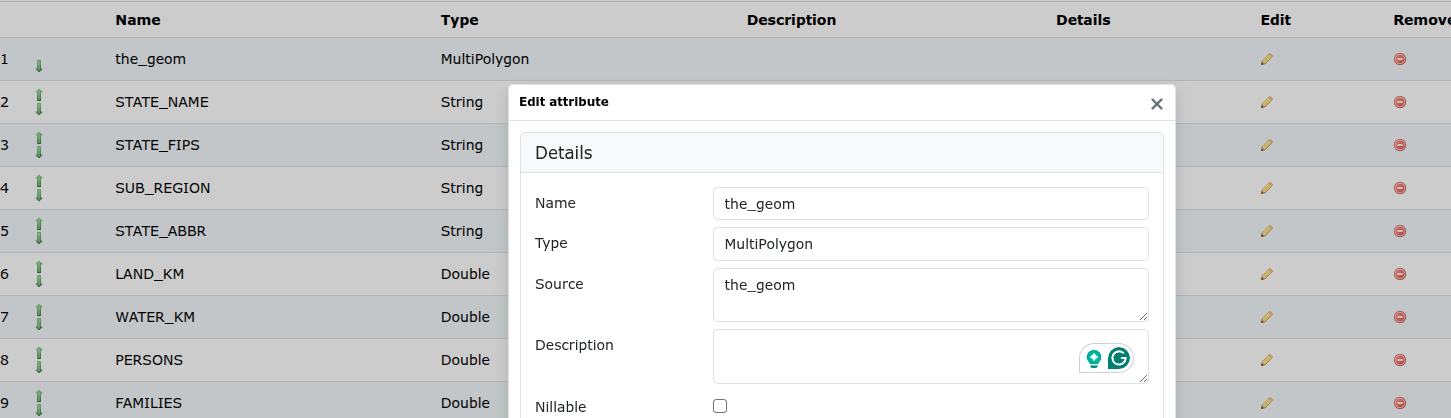
While attributes don’t have a title, they can have a description (enable attribute customization):

If the user is careful to enter a short description, it could well work as a “title” too… The alternative is to add a proper title in there too, for OGC API usage (this is a larger modification) of course, but it would be better from a long term perspective, as one day the title might show up and the description would then have to used for the same named schema property.

Cheers
Andrea

1 Like